Whetstones sharpen kitchen knives best. They remove very little metal, they give you full control of the angle, and they work on almost every blade. Still, the right tool for you depends on your skill level, your budget, and how much time you want to spend.
This guide compares the most common options. You will see how whetstones, honing rods, electric sharpeners, and guided systems perform. Then you will learn how to match each tool to your knife. Finally, you will get a simple test that shows when a knife needs sharpening and when it only needs honing.
Most home cooks skip that last step. As a result, they buy the wrong tool or wear down good knives too fast.
Whetstones: The Best All-Around Tool for Sharpening Kitchen Knives
A whetstone is the best all-around sharpening tool for kitchen knives. It removes metal slowly, so your knives last longer. It also lets you choose the exact edge angle.
How a Whetstone Works
A whetstone is a flat block of abrasive material. You glide the blade across it at a steady angle. The stone grinds a fresh edge on both sides. Because the surface is flat, it creates a clean, even bevel that other tools rarely match.
Stones come in two main types. Natural stones are quarried and often cost a lot. Synthetic stones are made in factories and cost less. For most home cooks, a synthetic stone is the better pick. It cuts faster and performs more consistently.
Which Grit to Buy
Grit tells you how coarse a stone is. A low number means a coarse stone. A high number means a fine stone. These ranges are a general guide, so check the maker’s chart too.
- 200 to 400 grit: repairs chips and badly damaged edges.
- 800 to 1000 grit: sharpens a dull knife.
- 3000 to 6000 grit: polishes the edge for smooth, clean cuts.
If you want just one stone, buy a combination stone. It usually has 1000 grit on one side and a finer grit on the other. That single block handles most kitchen jobs.
A Marker Trick to Find Your Angle
Holding the right angle is the hardest part of using a stone. A permanent marker makes it easy to check. Color the edge of the blade with the marker. Then make three or four passes on the stone.
Now look at where the ink is gone. If the ink stays near the very edge, your angle is too low. If the ink vanishes only at the edge, your angle is too high. When the ink wears off evenly, you have found the right angle.
Drawbacks of Whetstones
Whetstones take practice. Your first few sessions may feel slow. In addition, the stone wears down in the middle over time. A cheap flattening plate fixes that problem. Some stones also need soaking before use, while others do not. Always follow the maker’s instructions.
Honing Rods: Straighten the Edge, Don’t Sharpen It
A honing rod does not sharpen a knife. It realigns a bent edge so the knife cuts well again. Use it often, and use it lightly.
Why Honing and Sharpening Are Different
With daily use, the thin edge of a knife folds slightly to one side. Honing pushes it back to center. Sharpening, by contrast, removes metal to create a brand-new edge. For this reason, honing helps between sharpenings, but it cannot replace them.
Choosing the Right Rod
Steel rods are common and work well on softer knives. Ceramic rods are slightly abrasive, so they also remove a little metal. Many experts warn that hard Japanese knives can chip on a steel rod. A fine ceramic rod is the safer choice for those blades.
Keep your technique simple. Use a few gentle strokes per side. Light pressure is enough. Pressing hard does more harm than good.
Electric, Pull-Through, and Guided Sharpeners: Fast Solutions and Key Trade-Offs
Electric and pull-through sharpeners offer unmatched speed and convenience, making them ideal for home cooks who need a razor-sharp edge in under a minute. While guided systems provide precise angle control with minimal effort, these automated mechanisms tend to grind away more blade material over time than a traditional whetstone. Balancing efficiency with long-term blade preservation is key to choosing the right tool for your cutlery just as keeping your entire kitchen fleet properly maintained elevates your culinary craft, much like knowing master cast iron skillet care easily ensures your pan stays seasoned and non-stick for generations.
Pull-Through Sharpeners
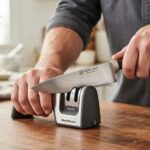
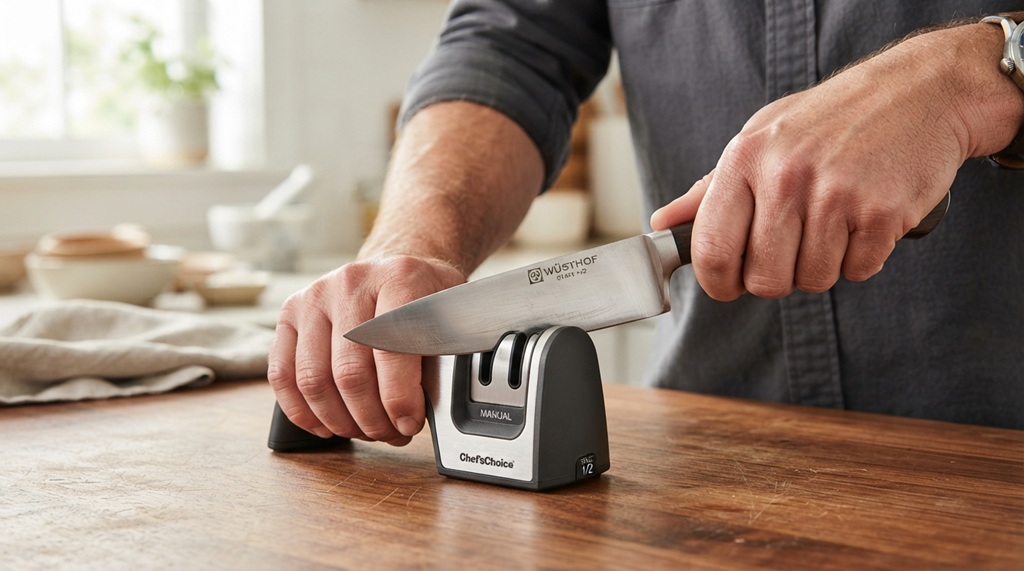
You drag the blade through a slot that holds fixed abrasives. These tools cost little and need no skill. On the downside, the fixed angle may not match your knife. They can also wear the edge unevenly. Use them for budget knives or as a quick fix.
Electric Sharpeners
Motorized wheels do the grinding for you. Good models have several stages and built-in angle guides. They work well on standard Western knives. However, they can remove more steel than needed. Most also do not suit thin Japanese blades. Look for a model that lists the exact angle it uses.
Guided Sharpening Systems
A guided system clamps the knife in place. You then slide a stone along a rod at a fixed angle. Because the angle never changes, beginners get sharp edges fast. These kits cost more than a basic stone. Still, they are a smart middle path if you want whetstone results without the learning curve.
How to Match the Sharpening Tool to Your Knife
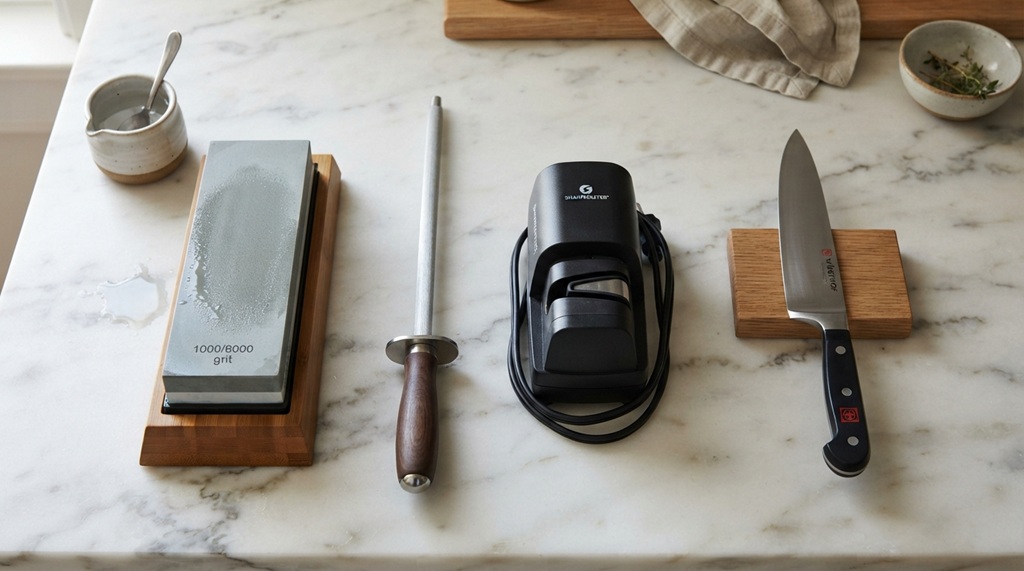
Match the tool to your knife’s steel and edge angle. This choice matters more than the brand you buy. Many people overlook it, yet it often decides whether a sharpener helps or harms.
Softer Western Knives
Many German and French kitchen knives use softer steel. Their edges are often near 20 degrees per side, according to many knife makers. These knives handle pull-through sharpeners, electric models, and steel rods well. A whetstone still gives the best edge, though.
Harder Japanese Knives
Many Japanese knives use harder steel and a thinner edge. Their angle is often near 15 degrees per side. Harder steel holds an edge longer. However, it also chips more easily. Therefore, choose a whetstone or a guided system. Avoid aggressive machines and fixed-angle slots.
Serrated and Budget Knives
Serrated knives need a tapered rod that fits each scallop. A flat stone cannot reach those curves. Budget knives are different. They cost so little that a simple pull-through sharpener is often good enough.
Sharpen or Hone? A Quick Test Before You Pick a Tool
Try the paper test first. Hold a sheet of paper and slice down through it. A sharp knife cuts cleanly. If the blade snags or tears the paper, the edge needs work.
Signs Your Knife Needs Sharpening
Watch for these clues in your daily cooking:
- The blade slips off tomato skin instead of biting in.
- It crushes herbs instead of slicing them.
- You need extra pressure to cut an onion.
- Honing no longer improves the cut.
A Simple Routine That Works
First, hone your knife before or after each use. Next, run the paper test once a week. If honing fixes the problem, you are done. If it does not, sharpen the knife on a stone or another tool. According to industry experts, many home cooks only need a full sharpening once or twice a year. Your own schedule depends on how much you cook and what you cut.
FAQ: Sharpening Kitchen Knives
What is the best sharpening tool for a beginner?
A guided sharpening system is the easiest start. It holds the angle for you. A combination whetstone is also a good choice if you are willing to practice.
How often should I sharpen my kitchen knives?
Sharpen when honing no longer restores the edge. For many home cooks, that means once or twice a year. Heavy daily use may call for more.
Can a honing rod replace sharpening?
No. A honing rod only straightens the edge. It does not remove metal or create a new edge. Sooner or later, every knife needs a real sharpening.
Are electric sharpeners bad for knives?
Not always. Good electric models work fine on sturdy Western knives. However, they remove more metal than a stone. Avoid them for thin, hard Japanese blades.
Is professional knife sharpening worth it?
Yes, for valuable knives or if you dislike doing it yourself. A skilled sharpener can restore a badly damaged edge. The cost is often small compared with the price of a good knife.
Conclusion: Pick the Tool That Fits Your Knives and Your Habits
Whetstones sharpen kitchen knives best because they offer control and remove little metal. Honing rods keep the edge straight between sharpenings. Electric and pull-through sharpeners save time, but they cost you more steel. Guided systems give beginners a safe way to get great results.
In short, start with your knife. Check its steel and angle, then choose the tool that suits it. Add a honing rod, run the paper test weekly, and your knives will stay sharp for years.